
Tianya Pan (潘天涯)
Master's Student
School of Computer Science, Hangzhou Dianzi University
Links
About Me
I am a Master's student in Computer Science and Technology at the School of Computer Science, Hangzhou Dianzi University, where I also received my Bachelor's degree. My research interests include data visualization, intelligent agents, and human-computer interaction, with a focus on building interactive systems that make complex data easier to explore, analyze, and understand.
Education
- M.S. in Computer Science and Technology, Hangzhou Dianzi University Sep 2025 – Jun 2028
- B.S. in Computer Science and Technology, Hangzhou Dianzi University Sep 2021 – Jun 2025
Publications

GraphQAG: A Knowledge-Graph-Guided Visual Analytics Framework for Question-Answer Pairs Generation
A knowledge-graph-guided visual analytics framework that generates high-quality QA pairs from long documents by constraining and guiding LLM-based generation with entities, relations, and multi-hop paths, while using the graph as an interactive interface for exploring coverage, provenance, and refinement.
arXiv preprint arXiv:2607.27182, Jul 2026
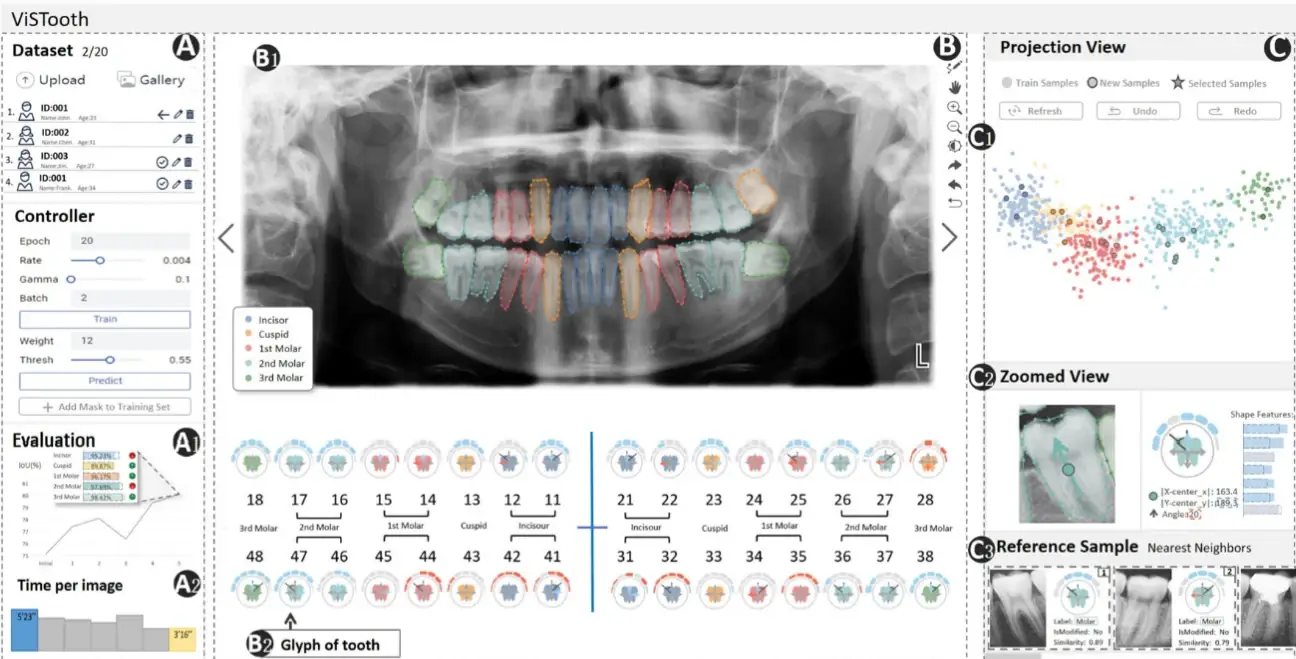
ViSTooth: A visualization framework for tooth segmentation on panoramic radiograph
We propose ViSTooth, a visualization framework for tooth segmentation on dental panoramic radiographs. Mask R-CNN performs preliminary segmentation, and a set of domain metrics (tooth shape, position, and angle) estimates segmentation accuracy. Teeth are represented as high-dimensional vectors and visualized in a low-dimensional space, allowing experts to inspect specific teeth, expand the training sample set, and iteratively refine the segmentation model. Case and expert studies demonstrate its effectiveness in accurate, expert-guided tooth segmentation.
Journal of Visualization, Oct 2025
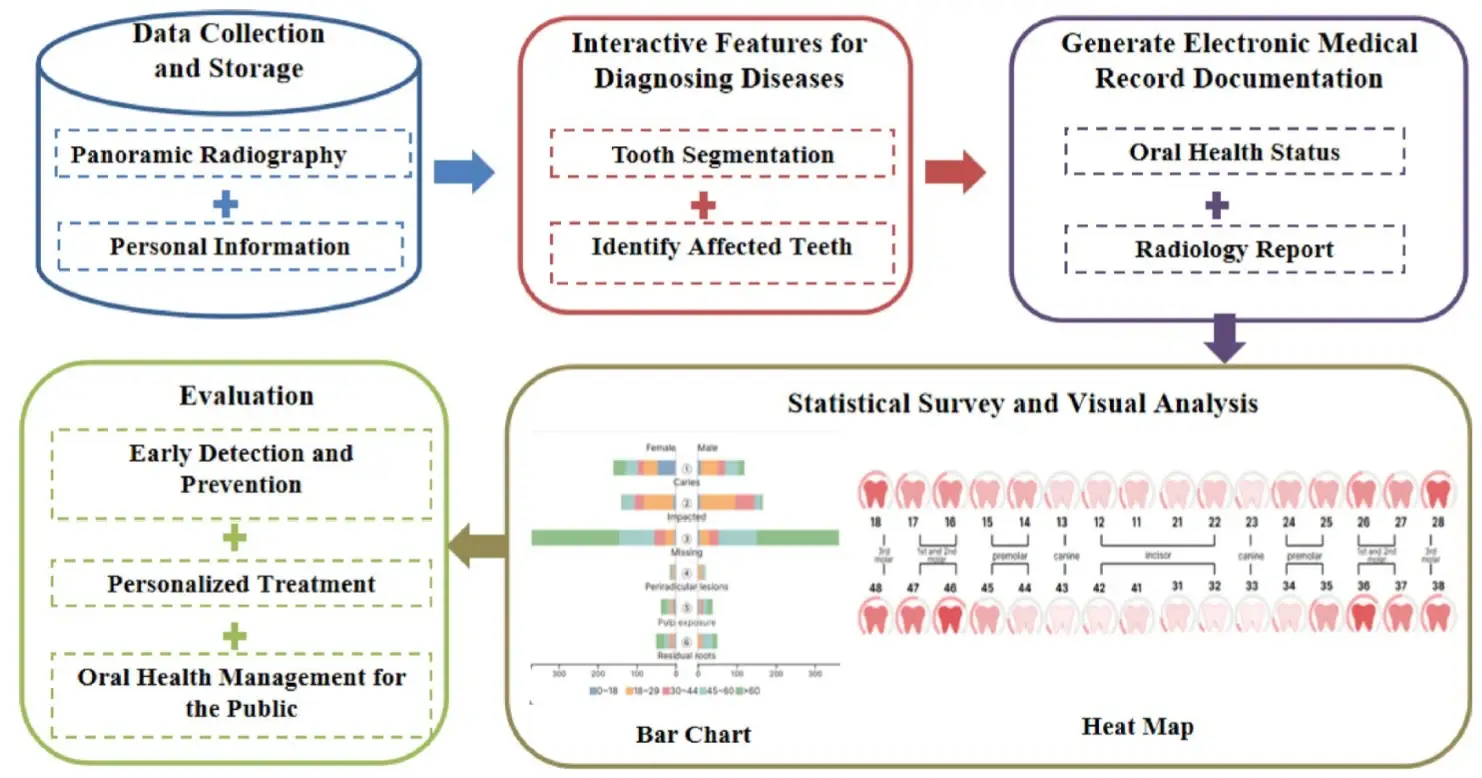
A visualization system for intelligent diagnosis and statistical analysis of oral diseases based on panoramic radiography
We develop a visualization system based on panoramic radiographs for the intelligent diagnosis and statistical analysis of oral diseases. A human-machine collaborative tool supports diagnosis and data extraction, generating electronic medical records with visual charts of oral health status and radiology reports. Statistical correlation analysis enables interactive exploration of oral health survey data. Evaluated on 521 panoramic radiographs, the system improves the efficiency of disease detection and data mining, covering disease-prone teeth, disease distribution per tooth position, and associations of age and sex with oral diseases.
Scientific Reports, May 2025
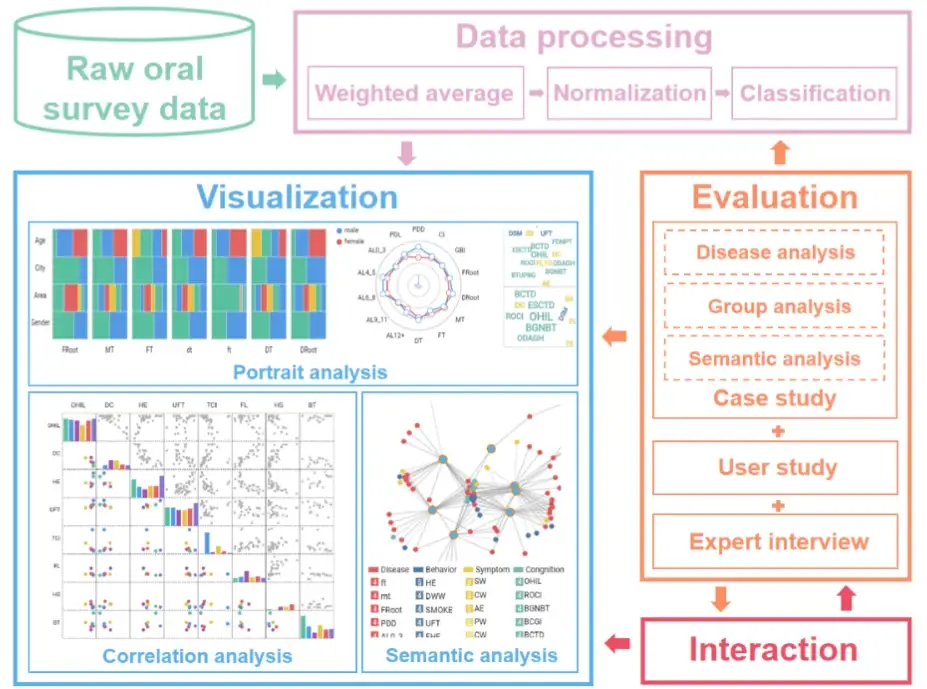
Visual analytics of multidimensional oral health surveys: Data mining study
We present a visualization framework for the visual analytics and deep mining of multidimensional oral health surveys. Diseases and groups are embedded into data portraits based on their multidimensional attributes; group classification and correlation pattern extraction explore relationships among diseases, behaviors, symptoms, and cognitions. A knowledge graph integrates semantic information and graph query functions, and a series of user-friendly interactions help users intuitively understand oral health status and conduct in-depth exploration. Case studies on real-world datasets demonstrate the effectiveness of the system.
JMIR Medical Informatics, Aug 2023
Patents
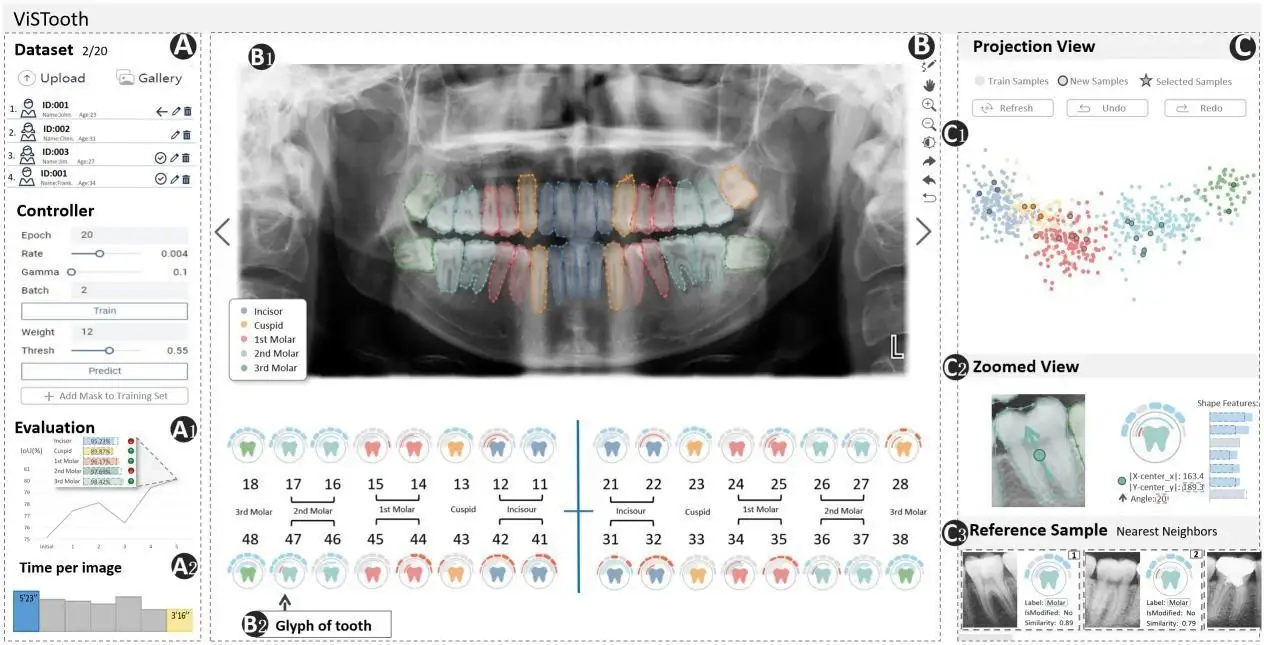
A Human-Machine Tooth Segmentation Method Based on Deep Learning
A human-machine collaborative tooth segmentation method for panoramic radiographs. Mask R-CNN segments teeth with feature maps for different tooth categories; feature extraction evaluates the segmentation results, which are presented through visualization. Interactive tools allow experts to correct segmentation results, and the corrected high-quality samples are fed back to the model for adaptive iterative optimization, significantly improving segmentation accuracy and efficiency.
Chinese Invention Patent (Application No. 202411293622.8), Publication No. CN 119273701 A, Jan 2025
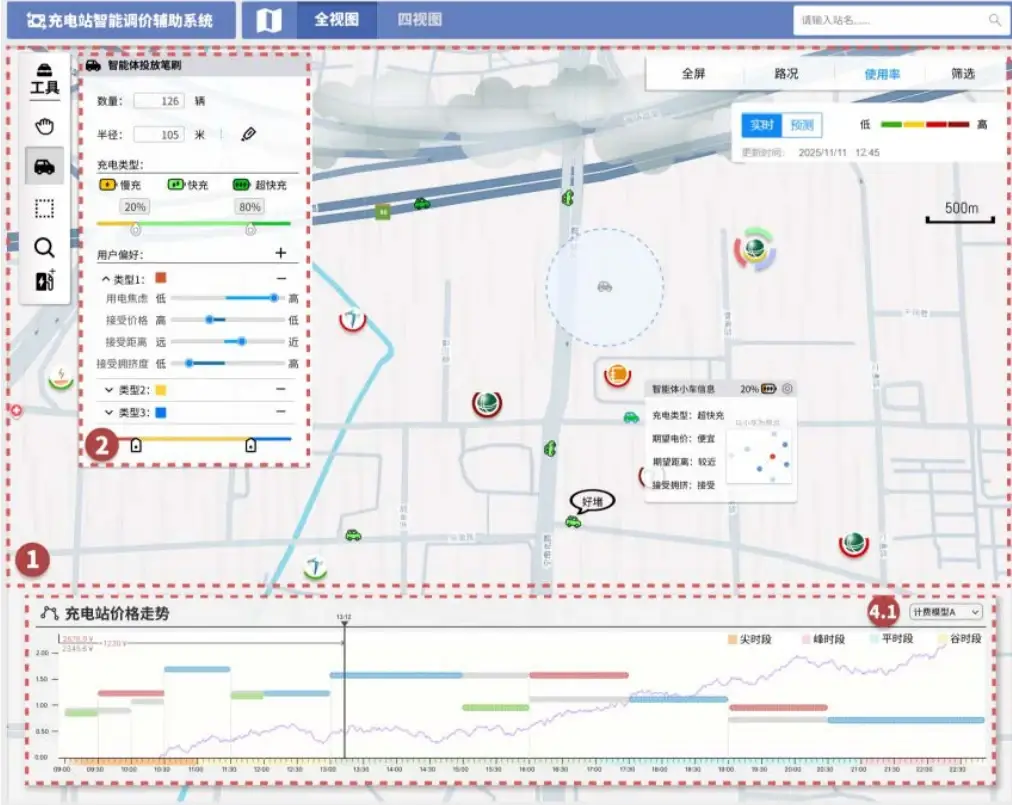
A Service Sequence Optimization Method, Device, and Medium for Electric Vehicle Charging Stations
A dynamic pricing and service sequence optimization method for EV charging stations. A multi-dimensional database is built from time-of-use tariffs, user data, and station data to construct an initial dynamic pricing model maximizing total revenue. A simulation environment with electric-vehicle agents and charging-station agents trains the model via reinforcement learning, which then outputs dynamic service fee sequences, overcoming the weak revenue-control capability of fixed time-period pricing.
Chinese Invention Patent (Application No. 202511843791.9), Publication No. CN 121766831 A, Mar 2026
Projects
-
OpenHarness
Creator & Developer
A local-first desktop agent workspace for office and knowledge work, built around session-scoped context: attached files, tool permissions, searchable and branchable transcripts, and schedules persist with each session instead of resetting after an answer. Agents run on any OpenAI-compatible provider with per-model capabilities, and API keys remain in the OS credential store rather than config files. Shell, file-write, web-fetch, and MCP tool calls are gated per category by ask/allow/deny policies and recorded in the transcript. Recurring prompts become interval or daily scheduled sessions with live status, while document, spreadsheet, and research output stays grounded in explicit units, formulas, and the sources actually read.